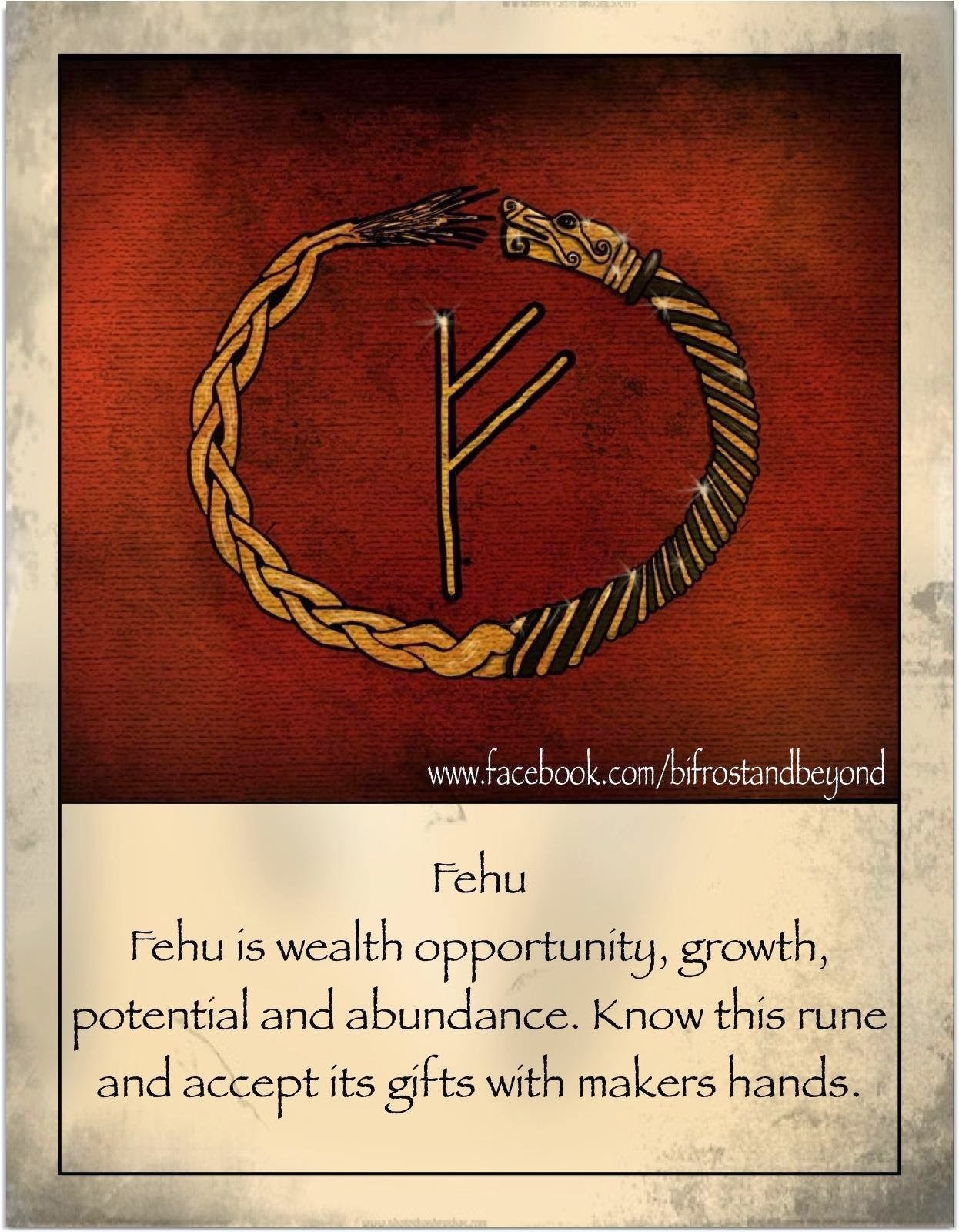
Showing posts with label Fehu. Show all posts

Tuesday, July 31, 2018

Runes 402 - Rune Dialogues - Get out of the Funk

In the past few months, more and more people have come to me seeking guidance from the Runes about how to get out of the funk that is surrounding them, how to deal with the chaos that seems to be invading the world, and to simply get out of the rut that they're in.  In short, more than at any other time I can remember in the past few decades, people are feeling discouraged, sad, frustrated, and even angry most of the time.  This is true on multiple levels - the individual, community (regional, national), and global levels.

When a friend of mine told me that she just wants to be happy again, but can't seem to find a way, that prompted me to write about this general sensation through a dialogue with the Runes.

I began the conversation by asking a basic question: When we're in a funk, how can we get out?

Normally, the answer comes in a single Rune, but this time, the Runes gave me three - Jera, Gebo, Berkana - to acknowledge the situation and reframe our thinking.

Runes:  Jera is the Runes of the year, and there can be no doubt that the past year (past while) has been hard - the growing funk to which you refer.  This gives your question context.  Gebo also presents us with a challenge in two ways.  First, we have been giving of ourselves and not in the usual willing way (not out of choice, but out of circumstance), but we must find a way to change the tide of things.  That is the second part - the challenge.  How do we turn something that seems to be a negative into a positive?  Berkana affords that conscious beginning.  You are acknowledging that you want to change things.  That is the starting point.  Now, is the time to take action.

Me:  But how?  What is that step?

Runes:  Begin by acknowledging your funk and accepting the challenge it presents.  With that recognition comes the opportunity to begin to address it.  To take a first step. Let Raido set the path for that journey.  Raido falls under Jera (see image above), to remind you that the journey will take time.  Eihwaz, the yew tree, represents your inner strength; it is what will help you face the challenge of the funk that Gebo gives, and step away from it.  One of the easiest ways to find the strength to begin is to use Fehu find something that you value.

Me:  That makes sense, but it can't be that simple.

Runes:  It is true that some things are easier said than done, but sometimes humans make things harder than they need to be.  Mannaz, the Rune of Humanity, embodies this struggle, but it is also a reminder that humans are not perfect.  Mistakes will be made, but working to correct them and to ultimately make the change you want is all part of Mannaz.  Fehu, once again, reminds you that if you really want to make a change, focus on something that you value, something that is important enough to you that you are willing to do something about it.  Don't try to do it all or be everything to everyone or every cause.  When you are in a rut or funk or everything seems like it has gone to shit, you cannot keep doing things the same way.  Kenaz represents creativity and innovation.  Find a new approach, but don't give up.

Me:  Thank you.  That does help to clarify things.  It is important to remember that most of what we do is our choice and I think those Runes remind us of that.  It sounds like we have to focus on our individual actions.

Runes:  That is true, but individuals don't function on a singular level.  Within each of us are small daily things that we do that build on larger ideals that we continue to aim for.  For example, it is fair to say that people want to be happy, but happy is a broad, higher level way of being.  Wunjo represents that goal.  But how does one achieve it?  They achieve it by empowering themselves through those smaller daily activities.  There is a lot of power behind this simple statement.  Thurisaz, the thorn Rune, is a Rune of power.  As you build that power or empowerment, and channel it toward the things that you value, you will be able to manage the rut, funk, and chaos found in Hagalaz.  Remember, the hail Rune has two parts - the initial destructive force and the beginning that happens once the hail melts.  If you are working toward that higher level joy, and can remain focused on that, you will be able to deal not only with this funk and chaos, but the next round that may come your way.

Friday, March 30, 2018

Runes 101 - Runes in History - Blekinge Sweden

Of all the places in Sweden that have Runestones, why should I choose Blekinge, in the southeastern part of the country on the Baltic sea?  I mean it has only three Runestones of the roughly 2,000 that are in Sweden.  However, these three share a few similarities.  The are all dated to between the years 500-790; they were all carved in a Proto-Norse version of Runes, which were used during the transition from the Elder to Younger Futhark; and, they are linked to the same tribe.  I believe they are all also designated to the same clan.

Blekinge used to have four Runestones, but one - the Gummarp Runestone - was destroyed in the 1728 Copenhagen Fire that burned almost half of the older section of the city.  The interpretation of these Runes comes down to two options - Haþuwulfar carves them for himself or they were carved in his memory.  Either way, three staves were carved for him - fff.

Fehu, Fehu, Fehu - wealth, wealth, wealth

Istaby Runestone
Haþuwulfar also appears on the Istaby Runestone.  Here, Haþuwulfar refers to himself as Heruwulfar's son and he is paying tribute in memory of Hariwulfar.

The names are what make this Runstone so interesting.  As you may have surmised, 'wulf' means 'wolf'.  'Hari' and 'Haþu' mean 'warrior' and 'battle' respectively.  The warrior wolf and battle wolf are part of a larger clan that may have incorporated wolves or the idea that wolves are a pack or family into rituals and religious ceremonies to initiate young warriors into the fold.

To see this Runestone, you need to visit Stockholm as it resides in the Swedish Museum of National Antiquities.

The Third Runestone is where things start to get really interesting, because this is where the curses come in.  Lying face down, surrounded by five other stones that formed a pentagon, the Stentoften Runestone was discovered in 1823.  In 1864, it was moved to the church of Sölvesborg.

Stentoften Runestone
The carving on this stone talks about how dwellers and guests [of]  Haþuwulfar had a bountiful harvest.  In part, this carving uses the Younger Futhark version of Jera to represent the harvest.  There are other Runes on this stone, like Kenaz, that are in the transitional form from the Elder to Younger Futhark.

An animal sacrifice occurred either to help with the good bounty or to give thanks for it.  This part is unclear.

You should also be warned that, "I, master of the runes(?) conceal here, runes of power, incessantly (plagued by) maleficence, (doomed to) insidious death (is) he who this breaks."  So, I highly advise that you don't break it.

Björketorp Runestone
The only one of Blekinge's Runestones that still resides in its original location is the Björketorp Runestone, located east of Ronneby off of E22.  One of the tallest Runestones in the world, it forms a circle with two other large stones called menhirs, because nothing is carved on them.

One of the lines on the stone matches almost exactly, in words, the line from Stentoften.  However, scholars say that the two stones were not carved by the same runemaster.  It says, "I, master of the runes(?) conceal here runes of power. Incessantly (plagued by) maleficence, (doomed to) insidious death (is) he who breaks this (monument)."  This stone, however, goes one step further, including a prophesy of destruction.

Scholars have put forth a host of potential meanings for these stones.  The one I like is the notion that these Runestones marked a border between different clans, possibly Swedes and Danes.

Saturday, December 23, 2017

2018 Merry Wishes

Before the year ends, I want to send you merry wishes for the new year.  I chose Fehu to represent these wishes, because of the perspective it holds.

Fehu is the cow Rune. In times long past, cows represented wealth.  Today, we have a great tendency to interchange the idea of wealth with money without making an important distinction.  They are not the same thing.  Money is money.  It is designed to be a tool used for the exchange of goods and services. Money is also a form of wealth, but wealth is not purely money.  Wealth can be a whole variety of things as evidenced by Fehu, the cow.

Each one of us defines what wealth is to us.  It can be a roof over our head, a vehicle...a whole myriad of objects; but it can also be a friend, a pet or our family.  Perhaps it's a job or a skill, a hobby or a walk in the woods or on the beach.  It can be our health or something as simple as a smile.

However you define wealth, Fehu serves as a reminder of that wealth in our lives.  Take some time, before 2017 melts away, to sit with Fehu to ponder the wealth in your life and to recognize and appreciate what you have.  Let that carry you into the new year, not only providing a foundation for you you, but let it guide you peacefully to the wealth you still seek.

And, thank you for being a part of the wealth in my life.  I am grateful for everyone who reads my blog and engages with the Runes.  Happy 2018!

Monday, October 6, 2014

Runes 402 - Rune Dialogues - Learning New Tricks

I've never been a fan of the saying, "You can't teach an old dog new tricks", especially when you're talking about teaching a human new tricks... or skills.  I think, in most cases, if you are committed to learning something, "you can learn whatever you set your mind to".  It's a much more empowering line of thought anyway.

I entered into a dialogue with the Runes about the idea of learning new tricks, because I wanted to know what drives us to learn new things, what barriers we put up for ourselves along the way, and how to overcome them.

Note the sword shape of the Runes as
they were laid out during the dialogue
Me:  Do you believe that people can learn whatever they set their minds too?

Runes:  Sowilo is a good place to start.  It gives cause for hope.

Me:  Thank you for starting us on this positive note.  Sowilo does lift the spirit.  It is a very positive and empowering Rune.  So, does it give us incentive to try something new?  That is to say it important to have the incentive if we want to be successful?

Runes:  You must have a desire to accomplish it, for it is akin to undertaking a journey.  Raido tells us that.  Raido also reminds us that such journeys are not always easy.

Me:  But, once we complete them, the results are satisfying.

Runes:  That is not always the case.  Tiwaz shows us that there is always some sacrifice that must be made.  As the warrior Rune, it is also good to have here, because you need to remember that you are capable of completing the task, that it will not necessarily be easy or as easy as you hope, and that there may be times when you want to quit, but those are the times you need to be strongest to see the journey through to the end.  If nothing else, you can say you completed the task before you.

Me:  That is an important reminder; thank you.  When things become challenging or we consider quitting, what can help us to continue?

Runes:  Fehu is the reward.  It is wealth in some form, whether it be financial riches or something else.  Sometimes we think you undertake new things for some sort of financial compensation, but, in the end, the actual reward can be a friendship that develops along the way.  It can be discovering a new way to do something, it can help you to better understand an aspect of who you are or make you realize that the mental, emotional or spiritual growth from the experience is what matters the most.

Me:  That is a great way to view the experience and to remind us to keep our expectations open.  I appreciate that guidance.  Along the way, we may come up against barriers.  I think we are more determined to overcome the barriers placed in front of us by others than we are those we place in front of ourselves.  What can we do to overcome internal blocks?

Runes:  For this, I give you three Runes - Wunjo, Uruz, Isa.  When you undertake something new, it is because you believe that by mastering it or gaining a better understanding of it, you will be more content.  It is important to remember that ideal.  When you set out on Raido's journey, you feel empowered by Sowilo's light and that energy carries you forward for a while.  Part of what drives you forward is Uruz.  Uruz is strong and free; in some ways fearless, but sometimes a pause is required to examine the steps you are taking on the path to make sure you are going in the right direction and how quickly you should move forward.  Isa gives you the time you need, the pause.  You must remember that it is okay to sit and contemplate before taking another step.  The trick is not to sit for too long.  Hesitation for too long can prove to be the biggest barrier to completing a task; it allows fear to develop and creates a snowball effect that can stifle the entire process.

Me:  That is great advice; thank you.  Will you show me Jera now to remind me that learning something new is a process.

Runes:  No, but it is good that you realized Jera is part of it.  Learning something new takes time and Jera is definitely about that.  What I give you here, though, is Ehwaz, to remind you of a few other equally important things.  No matter what you are doing, you are not alone and Ehwaz symbolizes relationships and partnerships.  Do not be afraid to ask for help.  It is also about loyalty and how you get from point A to point B.  At its most basic, Ehwaz is the horse, an extremely important mode of transportation and a loyal companion.

Me:  I appreciate your wisdom.  Is there any final information you would like to share?

Rune:  Ansuz.

Me:  Of course, wisdom, communication.  All important things to bear in mind as we endeavor to learn new tricks.  We gain wisdom through these experiences and the benefits and experience will be greater if we communicate through the process.  Thank you for your wisdom.


Tuesday, June 24, 2014

Summer Solstice Runes

Saturday marked the first day of summer (up north) - the solstice.  Last year, I wrote about Runes for the Solstice and decided to inquire about this powerful time of year once more.  While last year's post was more about making the most of the energy and power of the solstice, this year, I asked more about being with the solstice, connecting with it.  The Runes offered their usual keen insight, including a reminder that last year's question still applies.

The first Rune they gave to me was Dagaz, the day Rune.  There is not a more appropriate way to begin to address my question, than there is with the day Rune.  It reminds us simply that the summer solstice is the longest day of the year.  We should acknowledge the time we have to get things done; whether it's work or play, Dagaz lights the way and helps us see things more clearly.  In a way, this enhances our ability to be aware of this energizing time of year.  We can enjoy the warmth and feel hopeful not only about what lies ahead, but about what we've accomplished so far.  In essence, we can be in the present without worry of the past or what the future holds.

Fehu is the cattle Rune, representing money and prosperity.  Two weeks ago, I wrote about Runes for You and Fehu came up there as the Rune from Verdandi (the present).  How timely that, as Dagaz tells us we can be in the present, we draw Verdandi's Rune from two weeks ago.  In that post, I focused on the Rune poem meanings for this Rune and the idea of spreading the wealth/equity.  However, it is important to remember that, in today's world at least, wealth and prosperity can mean far more than simply money.  Given this high energy time of the year and Verdandi telling us to share the wealth, we should focus on sharing all forms of it, not just money - being kind to others, spreading joy and positive energy, doing even small things that could have a big impact.  What wealth do you have that you can extend to others?

As if Fehu's notion of giving to or sharing with others wasn't enough, Ehwaz is our final Rune.  The horse Rune, signifies many important and practical aspects to life that relate to interacting with others and forming relationships, such as loyalty, teamwork, and partnerships.  In this way, Ehwaz supports Fehu, by saying, "We are all in this (life's journey) together."  And, we should try to make the journey a pleasurable one for everyone by doing our small part.  It may even be that the attributes of Ehwaz are the wealth we can spread.

The summer solstice is a powerful time of year. We can make the most of its energy by coming together to share all forms of prosperity, which connects us with this solstice's power and enriches us and those around us.

Monday, June 9, 2014

Runes for You

After a completely crazy week and the need to let go and forget it over the weekend, I realized that I could not write the post I had planned, because I did not have the time to finish the book I'm currently reading to review.

However, because the Urd, Verdandi, and Skuld always have wisdom to share, I called on them through the Runes and asked them what knowledge they would like to tell me about your past, present, and future - 'you' representing both you personally and the larger societal you.  Yes, a Norn cast for you.  Here is how they lined up:


Urd, representing your past, showed Laguz.  In this instance, the water Rune represents your past and and you must consider that past as part of your life going forward.  Just as water nourishes you, so too does your past, though in a very different sense.  Where water provides for your physical existence (by drinking it, using it water food, and for cleanliness among other things), your past provides mental nourishment.  Your past experiences have taught you lessons and prepared you for each step forward that you take.  Coupled with this are the mysteries held in a deep or stormy sea.  They can be scary, but you cannot be afraid to try new things; remembering that all of your life experiences up to this point have helped to prepare you for the next challenge you face, the next choice you make.

Verdandi gave me Fehu, the cattle Rune, which symbolizes your present and equates generally to finances.  The Rune poems for Fehu are quite interesting, for while they all clearly call it money, the Old Icelandic and Norwegian poems point out that it causes quarrels among kinsmen, and the Old English poem almost counters that with the suggestion of sharing your good fortune with others - keep things somewhat equitable (perhaps to avoid quarrels and conflict).  I think this is indicative of our current society, where the wealth is being concentrated among the few.  Now is the time to take the lessons from your past and apply them to your current situation.  There are any number of sayings I could call on here to make this point.  How about Margaret Mead, who said. "Never believe that a few caring people can't change the world.  For, indeed, that's all who ever have."  This calls the idea of personal responsibility to the fore.  Add to that, "It is better to walk alone than with a crowd going in the wrong direction" (by Diane Grant), and you have a very powerful opportunity presenting itself.

Skuld offered Raido, the riding Rune.  Having just looked at Raido a few weeks ago, it is fresh in my mind.  Following on Verdandi giving us Fehu, Skuld showing Raido signifies change - a journey.  Essentially, your future should experience a change, it should be different from your present.  However, as we know, this is not a done deal with the Norns.  This is what should be, but only you can make it so.  You will never get where you want to be if you don't consciously undertake the challenges life presents.  You must take the reins and move or you will be moved in a direction you do not wish to be carried.  I will end with a quote from my Raido post, because it flows perfectly with the wisdom we have received from Urd and Verdandi.  In support of her sisters and through Raido, Verdandi says, "Don't just sit there while life happens to you; don't allow yourself to be a victim of your circumstances.  Take charge of where your life leads you." 

Monday, April 21, 2014

Runes 101 - Runes in Mythology - The Adventures of Merlin

Last week, I started watching a British fantasy show on Netflix, called The Adventures of Merlin.  Broadly based on King Arthur and Camelot, this show depicts Merlin and Prince Arthur as youth (Late teens, early twenties) and, even though Arthur's father, King Uther, has outlawed magic by penalty of death, there is still plenty of magic and mythology around, which is why this is a Runes in Mythology post.

In season 1, episode 6, a sorcerer comes to Camelot.  While I won't give away the plot, I will say this: he has a small box with him that's full of beetles which he can 'bring to life' and 'freeze' by chanting.  However, what makes the box interesting is that it has four Runes inscribed on it and looks roughly like this:


The first glance of the box caught my eye immediately and I can't tell you how many times I had to hit pause to capture just the right image of it to inspect the Runes.  Once I got it, a few realizations came to mind.

First, Othala is inverted.  Second, like Othala, the third Rune is also an 'o' Rune reversed and, as near as I can tell, from a Futhark called the Latinized or Medieval Futhark (which according to the source I found was used primarily for decoration and not actually for inscription).  Last, the first and last Runes are not etched exactly like the Elder Futhark Runes.


In fact, the 'f' Rune (Fehu) is curved and seems to derive from one of the Younger Futhark versions, while Jera is etched similar to the Elder Futhark, but not exactly, having more of a diamond shape to it, than the interlocked aspect it actually has.

I struggle with Rune usage such as this.  One one hand, I am happy to see the Runes being used and love that family and friends consult me immediately whenever they see anything the suspect is a Rune.  On the other, it bugs me that they are so confused and misrepresented, deriving from different futharks - Fehu from a younger Futhark;  Othala the Elder, but inverted; the third is an 'o' Rune from a medieval futhark; and Jera's similar depiction of the Elder, with a slightly off diamond shape.

Perhaps what struck me as being the most odd about these Runes is that they appeared in a show about Merlin and King Arthur.  I mean these tales are from England, so I would expect the Runes they use in the show to be from the Anglo-Saxon Futhorc.

Maybe I shouldn't dwell on such small details, but I can't help but feel like, in anything, if you're going to do it, you should do it as correctly as possible and this clearly isn't.  So, I'm torn - happy to see the Runes and to be able to recognize the short comings of their presentation, but disappointed in those same presentation errors.

Monday, March 31, 2014

Runes 202 - Bind Runes - Life's pursuits

I began a line of questioning with the Runes today that I intended to relate to job searches, changing careers, and the like.  However, as I contemplated and interpreted the meaning of the three Runes I received - Kenaz, Laguz, and Fehu - I realized that I was limiting them to a single parameter in life, when they applied easily to many pursuits.

Not only could I not confine these Runes, but I wanted to strengthen them by binding them together.  The final product may not look pretty, but it is a powerful reminder of a positive mindset as we endeavor into life's pursuits.


Although it's not the prettiest or most balanced bind Rune I've made, I love it just for the open visual.  This Rune looks like it is open to so many possibilities.  Beyond the visual, the Runes that are bound here are very uplifting.

I drew Kenaz first and its simplicity is revealed in this position.  Commonly referred to as the Rune of the light or torch, Kenaz represents human made fire, made using human creativity and knowledge.  This indicates to me that we should pursue those things that come naturally to us or that we have worked hard to learn and master.  That is where we will find satisfaction.  Even if it is not possible to undertake these things to earn a living, they must remain an active part of our lives, for they feed our joy.

Laguz was next.  Though I often say, "go with the flow" when this Rune appears, it is not simply a matter of kicking back and letting things happen to us.  We must still be active, preferably proactive in life's pursuits.  While we should try not to let things stress us out, we must also realize that life does not flow directly from A to B.  In other words, it's not going to be easy, but if we follow Kenaz (doing the things that come naturally or that we have worked hard to master), it will be worth it.  The thing to remember is that, like the depths of the sea, life is full of mysteries and, like the river making its way across the floodplain to the sea, life is also full of twists and turns, calm waters and rapids.  If we sit back and do nothing, those aspect's of life are going to kick our asses.  We have to navigate these parameters consciously.

I laughed a bit when I saw the final Rune - Fehu.  It seems to be counter to the implication of the first two Runes.  Where they suggest guiding our lives toward joy and contentment, Fehu is the cattle Rune' money; suggesting that money is the happiness we seek.  However, two points stand out against this idea.  First, whereas cattle used to be a form of 'money', in broader terms, it represents wealth and today wealth cannot be measured in terms of financial prowess alone.  The second point ties directly into that idea, because the Rune poems claim that those who have money should dole it out in abundance, essentially share the wealth, and that money is the source of a lot of arguments with loved ones.  In essence, don't put all your eggs in one basket - don't make financial wealth you're only goal.  Good health, good friends, a loving family, work that you enjoy or that allows you to do the things you enjoy, these are all aspects of wealth.  So, Fehu is not counter to Kenaz or Laguz; rather it reinforces them by making you consider the types of rewards you want to achieve through Kenaz and Laguz.

Separately, these three Runes offer important guidance in the pursuit of life.  Together, they unite our natural talents and acquired knowledge with our abilities to proactively navigate the twists, turns, and mysteries of life, and realize that money is only a single goal within and along that path; we will be far richer in the end, if we pursue good health, loving relationships, and activities we enjoy as we pursue financial security.

Monday, March 10, 2014

Runes 402 - Rune Dialogues - Following Two Paths

Through my most recent dialogue with the Runes, the importance of posing a question just right so that you can understand the answer the Runes offer and so they can understand the true intent of the question being asked, became very clear.  In other words, you have to ask what you want to know.  Don't be vague.

After about twenty minutes of engaging with the Runes over the weekend, I realized we were dancing around the actual question that I needed to ask.  More importantly, perhaps, I was waiting for the Runes to present themselves when what I needed to do was put forth the first Rune myself. Once that was sorted, I laid down Jera as the starting point.
Jera is the year Rune, the Rune of the harvest and the implied cycle or process to achieving a bountiful one.

As I set down this Rune to restart my conversation with the Runes, I asked how I can manage my time over the next year to 18 months as I follow two paths forward - one for my current situation and one that leads to a different future.  Essentially, how can I maintain the path I am required to be on right now, while ensuring that it will lead me to the path I want for the future?

The Runes responded by showing me Laguz, the water Rune.

Me:  Ah, Laguz.  But, you see, part of the problem is that I cannot relax and go with the flow.  I understand that I cannot push the river (control where and how water moves), but I need to define some sort of course to help me move forward.

Runes: Mannaz reminds you of who you are.  What are your strengths and weaknesses?

Me:  I don't understand.  What is the link between Laguz and Mannaz that you are wanting me to see?

Runes:  Fehu is a bad focus for making your plan.  Laguz is more than flow.  Many mysteries lie below its surface.  If you wish to focus on exploring those mysteries, you must be aware of your weaknesses.  Right now, that weakness is focusing on money.  You showed me Jera to start this, so focus on the process.  Even if money is the ultimate goal (or one of them), your focus should be on the next step, not on the final one.

Me:  Oh, I see now.  Thank you for that clarification.  You are correct and I do tend to jump ahead; that is why I laid Jera.  How do I stay focused on taking a single step at a time?

Runes:  Thurisaz will guide you.

Me:  But Thurisaz is a very powerful Rune and, if not managed well, the power unleashed by it can turn to chaos and create even more trouble.  That would not be good.

Runes:  You are a warrior, are you not?  Tiwaz shows you the warrior you are. Remember that one of the key aspects of a warrior is her strategic ability. You can manage your own power unleashed through Thurisaz.  Channel that power.  Do not be afraid.

Me:  That is true; I am a warrior, but I am also weary of letting my power get way from me, but you are right, I should not be.  And, what will happen if I do unleash it and maintain it?  If I can stay focused on each step and not jump ahead?

Runes:  These are the Runes you want to see in the future - Raido, Dagaz, and Wunjo.  If you trust in your abilities, and unleash them with focus and direction, this is the path that will reveal itself to you in the future.  Raido is your travel on  all aspects of this path.  It will lead you to a point where you can see things clearly, though they may not be so clear right now.  Once you can see things clearly and have a sense of where things are, you will be happier.

Me:  These are good Runes.  Thank you.  That is what I need to do - see opportunities clearly.  I am nervous about how good these Runes are though.

Runes:  You know the Norns.  Raido is your past (Urd) and path, the one that has led you this moment (Verdandi), where you are beginning to see shimmers of light from Dagaz, an end to an arduous journey.  Wunjo is what should be, according to Skuld.  It is still up to you to bring it to fruition.  Realizing that happiness is within your power can be overwhelming, but if it is what you truly seek, you will find a way to guide this path to it.  What you must decide is whether or not this is the path that will get you to Wunjo.

Me:  Thank you for your wisdom.  You have shown me how to follow two paths to secure my current situation and ensure my future one by looking simply at the next step and not focusing on the ultimate goal.

Monday, January 13, 2014

Runes 402 - Rune Dialogues - Time

Last week's post about releasing disappointment included two Runes related to time - Jera the year and Dagaz the day.  That, obviously, got me thinking about time, its various durations and how we use it.  In considering time, I also decided it was time to start a new series, Rune Dialogues, which relays the conversations I have with the Runes about certain topics. 

I began this time dialogue with our two time Runes from last week.  And, I can assure you, this conversation went nowhere near the subjects I imagined.  Instead, the Runes provide us with a foundation for the way we spend our time, rather than telling us specific tasks. 


Me: Last week, you gave me Jera as the second Rune of three, when I asked about releasing disappointment, and followed it with Dagaz.  These struck me as two very important Runes dealing with time, so I want to learn more about it.  Can you give me more details about time and how we use it or should use it?


Runes: In using time, making the most of it so to say, Dagaz is a good place to start.

Me:  Yes, last week, Dagaz told us to move out of the shadow and into the light.  Metaphorically, I took this to refer to our capacity to think critically, instead of responding emotionally.  Is that how we should begin, by thinking critically?


Runes:  Think of it in a more positive way.  Your ability to think and weigh situations is a step, but finding the positive aspect in this process is a true gift.  That is why I give you Gebo here, so that you can strive to find the positive aspects of the good and bad on your path.  It is also possible that others will see your ability to find and move forward in a positive way and reflect it in their actions too.

Me:  What is the best way to do that?


Runes:  Wunjo belongs here, because it works in two positive ways.  First, it simply reminds you to be happy.  Coupled with that, if you are true to a path that makes you happy, you will find a way to do things that not only make you happy, but that lead you to sustained happiness.

Me:  But this is all rather obvious.  I know I asked you how we should use time and your response - that we should use it to make ourselves happy and share that joy with others - is sage advice.  Thank you.  However, most of us, how ever well-intentioned, find it more difficult than it probably should be to follow that path and I believe it comes down to how we use our time.  So, can you be more specific about how we can follow your advice and use our time on things that make us happy?

Runes:  Fehu, Jera, and Othala.


Me:  I think I understand Jera as planning and process, and Othala as time with friends and family and building a happy home, but why Fehu?

Runes:  Remember, Fehu measures wealth. Cattle is not the only way to measure it, neither is money. Wealth is more than possessions.  How you measure your wealth and the things to which you assign value plays a great role in determining whether or not you are happy.  For some people, that translates into money (generally gained by working).  But work takes on many forms.  Growing a garden is work; it may not pay you much money, but it may give you peace of mind that you are growing your own food or beautiful flowers; it may just give you some quiet time to relax or time to reconnect with Earth.  So, as you are planning how to proceed on your path through time, keep in mind that money is not the only form of wealth and, once things are given their true value, the direction of your path or how you spend your time may change.

Me:  What if that which makes us happy is not very productive?


Runes:  Thurisaz will give everything its place.  You must realize that happiness unleashed through something that empowers you is very positive.  However, with Thurisaz comes great power, the kind you do not really want to mess with unless you can manage it.  The message here is two fold.  First, don't let the things that make you miserable control you - don't give them this great power - and, second, being happy does not mean being completely reckless either.

Me:  So you're saying that what makes us happy can also be detrimental to us, like the negative things in our lives, if we don't give it context within everything else and if we don't manage it?


Runes:  You must let your natural joy be free.  Think of it as Uruz, a wild ox, not cattle.  Approach it with caution.  Be aware of its power.  And realize that, if you work with that free energy, your time will be well spent and will benefit you and others greatly.

Me:  Thank you for sharing your wisdom with me today.

Monday, November 25, 2013

Runes 403 - Rune Interpretations - Resistance

There are two kinds of resistance - resisting things that you know are wrong and resisting things that you know are right.  Dealing with the former can mean simply not doing something you know is wrong or it can mean standing up to something that is wrong or unjust.  When you're passionate about a cause or protecting someone or something you love or believe in, resisting things that are wrong is relatively easy, because it thrives on the passion you feel.

However, that latter kind can be much more challenging - resisting something that is right.  Sometimes we know something is right, because we feel it intuitively.  We know, in our gut, that it's right, yet we resist it with every ounce of our being.  Why?  And how can we get out of that mindset?  How can we stop resisting the positive and embrace it instead?  That is what I asked the Runes this week.

A few weeks ago, I created a bind Rune for letting go of anger, but this is slightly different, as we are trying to let go of apprehension and stop resisting.  To address why we resist things that we know are right, I drew Ehwaz, Perthro, and Fehu.


Last week, I looked in detail at Ehwaz, the horse Rune. This week, that Rune came first to answer my questions.  Remember, that the foundation of Ehwaz was loyalty.  Receiving Ehwaz here suggests to me that, when we resist something that we know is right on an intuitive level, we are not being loyal to ourselves, not trusting ourselves.  So, first and foremost, the Runes tell us to trust ourselves.  We must listen to our inner knowledge (a topic - intuitive listening - about which I wrote on another blog earlier this year).

Still, we must also consider Ehwaz's other aspects and look at how those aspects help us stop resisting.  These considerations bring up a number of additional questions to address.  We are not in this alone, so if we stop resisting our intuitive knowledge, how will our actions affect those around us?  What happens if we keep resisting?  What happens if we stop?  Where will our path lead?  In looking at these questions, perhaps it is not that we don't trust ourselves, rather that the timing is not right as it affects others.  So, the Runes also tell us that, although we trust our instincts, sometimes we must consider the timing of acting on them.

Perthro, in the second position begins to shed light on the impact our choices have on others and vice versa; it reminds us that our wyrd (fate) is linked.  This suggests that, while we may know something intuitively and we may not want to resist it, we do, because the time to embrace it has not yet arrived.  I have touched on this idea in discussing anticipation and, earlier this month when I looked at the need to or importance of pacing yourself.  This perspective gives depth to our resistance, implying that we think of others as we make our choices, that we are not simply selfish beings.

The final Rune, Fehu - the cattle Rune - gave me pause at this juncture, because I just proclaimed that we are thoughtful beasts, not selfish or self-serving creatures.  Yet, Fehu represents wealth, riches, perhaps even greed.  Within a moment, though I was reminded that, while cattle may have been a primary measure of wealth in the past, today we measure wealth in more ways than one, from more than a financial perspective.  One of the greatest forms of wealth we possess is the ability to care for the welfare of others.  In this instance and tied to the idea of caring about others is viewing our ability to resist our instincts as a form of wealth.  It shows strength and helps to ensure that, when the time is right and we end our resistance, the benefits will far outweigh the struggle of resisting.

Monday, November 11, 2013

Runes 302 - Interviews - Bifrost and Beyond

This post not only marks the first in a new series - interviews, but highlights the work of a great Heathen artist, CSA, whose body of work is depicted as Bifrost and Beyond.  I've been familiar with CSA for a while now and even used one of his pieces in my post about the Norns.  It has become one of my favorite pieces of art, so I was very pleased when he agreed to this interview and to share some of his work with us.

Thank you, CSA, for taking the time to talk with me.

Many of your pieces contain Runes.  Can you tell us why and how you incorporate them into your art?
Runestorm
The Runes are ancient and timeless symbols from our past.  More than just a primitive form of writing, their simple shapes encompass a vast multitude of subtle and diverse meanings.  They empower us; they teach and guide us; they hold the secrets of the universe.  Sometimes, Runes will demand to be included in an image I'm working on, as they echo the meaning of the piece.  Other times, my work is inspired by contemplating a specific Rune.  I am in the process of producing a series of images based on meditations on the Runes of the Elder Futhark - it's been a really rewarding and enlightening piece of work and I plan to release the images as a book when they're complete.

The book sounds very interesting and the Runes play a key part of it.  How did you come to be interested in the Runes in general and as part of your art?
In my mid to late teens (a long time ago now) I went through something a lot of teenagers experience - a feeling of angst, not really belonging or having a place or purpose in the world.  It's not reflection on my upbringing, just a commonly difficult period of transition for young people when you feel like and adult, but the world still views you as a child.

Tyr woodcarving
In that time, I began to contemplate my heritage and ancestry - not just blood, but the soil I had been born and raised on.  There I found a rich history, culture and mythology that instantly struck a chord with me and that I could intuitively relate to.  I recognized the myths of the Norse and Germanic people as beautifully crafted metaphors for the cycles and phenomena of nature that I could see occurring around me.

It wasn't long before I became interested in the Runes and, after reading a couple of books, I decided there was no substitute for firsthand experience.  I created my first set from a piece of oak over twenty years ago and still have it today - those Runes are my most treasured possession.  Living and working with the Runes over such a long period of time, it's only natural that they would begin to feature in my artwork.

So, first you discovered the culture and myths, then the Runes.  How does that Norse experience inspire your art?  Norse, Anglo-Saxon, and Celtic, for example.
Thor
I love mythology full stop - the timeless tales of courage, heroism, love, beauty and tragedy.  It's impossible not to be inspired!  I feel a particular affinity with and my artistic style lends itself best to the mythology of the Norse and Anglo-Saxon cultures.  I naturally use cold grey and blue hues that reflect the colder northern climate; I tend to use sparse, simple backgrounds with bold, dominant characters, who look as if they were carved from a great oak or hewn from a rugged rock.  In that way, they represent the earth, the soil and the environment - the timeless essence that spawned such a rich and heroic mythology and culture.

What else inspires your art?
From time to time, I create work inspired by Greek, Roman or Celtic mythology.  Other inspirations have included Steampunk genre, the writing of H.P. Lovecraft, science fiction, and the Soviet era to name a few.

I'm really in the zone when working on the Norse and Anglo-Saxon theme though; that's where I work most intuitively and am, I think, at my best.

How long has this theme been the primary focus of your artwork?  How long have you been working with the Runes in this capacity?
Rather surprisingly, the Runes and Norse mythology have been my primary focus for only about two years.  I took a long break from any sort of creative endeavor in my mid-twenties, for no specific reason that I can fathom.

It was a chance encounter with a fantastic artist, painting in a shop window, that inspired me to engage in the creative process again.  We have remained friends ever since and he remains a source of encouragement and inspiration for me.  I guess, for the first few years, it was trial and error, trying to develop a style and experimenting with a range of themes and subjects.  I produced some pretty awful stuff back then, but I keep it as it marks a step in my journey.

It was only about two years ago that I really developed the style that I have become so comfortable with.  Initially, I was reluctant to work on anything Rune-based as that had always been a very private part of my life, but whenever I relaxed and just let myself draw almost subconsciously, the kind of images that related strongly to my experiences with the Runes came out and they were, by far, the most satisfying and meaningful things I had done.  This led me to ask myself, "What is art, if not a true reflection of the inner self?"

Ever since then, the Runes and Norse mythology and cosmology have been the driving force behind my work.  It really has been the most tremendous experience - externalizing my thoughts, feelings and interpretations really leads me to examine them from new perspectives and teach myself new things along the way.

Do you have a favorite piece that includes the Runes or Norse Mythology/Norse influence?  Can you tell us about the piece?
Algiz
"Algiz" is, by far, my favorite piece.  It's a portrayal of a potent visionary experience from many years ago.  The image is burned into my consciousness as if it were yesterday.  I always thought it would be impossible to replicate it in physical form, but I found that, as soon as I tried, it was pretty much instantaneous.  It's a technically simple piece, but it pulses with the energy of that experience and exudes everything I wanted to.

There's something very primal about it.  I like to watch people at my exhibitions and see which pieces engage them, which ones they stop and contemplate, which ones they talk about and so on.  Algiz has a tendency to stop people in their tracks and people with no knowledge of Runes or Norse mythology have approached me to say that they like it and to ask what it's about.

How do you use the Runes outside of your art?
I have used the Runes for over twenty years, very privately for the most part to meditate on and consider difficult situations in life.  I don't believe there is any clairvoyant "magic" in the common sense of the word behind the Runes.  Rather, I think that they channel the reader's intellect and intuition, prompting him or her to consider aspects of a situation they might not have otherwise considered.  They won't tell you your future, but will offer possibilities to influence your decisions.

Wunjo
Recently, I held some readings for friends, who seem to have found them very helpful and insightful.  Aside from divination, the Runes are part of my daily life.  I often find that a Rune springs to mind when I'm facing a challenge or difficulty and it offers guidance and inspiration and enhances my understanding of it and myself.  Other times, a sight, sound or smell will bring a Rune or a series of them to mind and bring me to contemplate the sensory experience - sometimes it's quite difficult to stay focused on the mundane, practical matters without such distractions!

As far as I am concerned, you can never master the Runes, only deepen your relationship with and understanding of them.  Their meanings and subtleties are infinite.

Do you have one special moment or unique experience with the Runes, where you had an epiphany or clarifying moment?
I do, although I prefer to keep these things close.  It's a fool who bares his soul for the world to see.

Where can people view and purchase your art?
Fehu
Currently, my primary exhibiting space is my facebook page, but I am also on Deviantart.

At the moment, I'm selling via PayPal. People can message me on my facebook page about the piece or pieces they want and I'll send them the payment details.

Because the majority of my work is digital, it provides tremendous scope; I can produce almost any of my images at any size on just about anything - a standard print, canvas, mug, T-shirt, mouse pad, whatever!

I'll be exploring eBay and one or two other avenues in the coming months; it just takes a bit of time to list the volume of work I have in an array of available options.

Thank you, again, for taking the time to share your art with us and tell us how the Runes inspire it!

CSA's Bio
Living in southern England, I have been a practicing Heathen for over twenty years.  I have a deep and intuitive relationship with the Runes and a strong spiritual bond with the mythology and cosmology of the Norse and Anglo-Saxon culture and with my natural environment.  All of these things influence and inspire my personal philosophy and artwork.  I strive to portray the values and ethics of Heathenism for what they are - courage, resilience, sacrifice, and heroism - but, at its purest level, Heathenism is the observance and honouring of the wonders of nature, understanding that all things are connected, that we all have a part to play and an influence in the grand scheme and, above all, trying to live a good life.

Monday, March 25, 2013

Runes 202 - Bind Runes 1

Bind Runes are something I've been interested in for a while now and, over the past two weeks, I've had a number of people ask me about them.  To that end, I decided to make my first conscious effort in creating one.  I say conscious, because in February 2012, I was writing about Making Alterations and I drew two Runes together that reminded me of a symbol I drew almost manically on my pee-chees (notebooks) in high school.  That was my first bind Rune, but it was completely unconscious and I didn't recognize the symbol as being Runes until fairly recently.

For my first bind Rune, I wanted to accomplish two things.  I wanted it to be very meaningful to me and I wanted it to follow up on my first Rune ritual, which I did earlier this year.  To that end, there were three components I wanted to include in my bind Rune - financial success, my writing and speaking endeavors, and Jera, which is my guiding Rune, so much so that I named my company after it.

These are all simple traits to represent with Runes - Fehu for financial success, Ansuz for communication, and Jera, the Harvest Rune, for Jera.  The challenging part was going to be Jera, because of its unique shape.  I decided to begin with the first two Runes, since I saw very easily how they could fit together.

As I drew Fehu, I repeated the chant from my Rune ritual, "Water is my element; Fehu is my goal."  When I added Ansuz, I said, "May Odin and Heimdall give my words, both written and spoken, an engaging tone.  I ask Freyja to help me write easily and well."

Once those two Runes were drawn together, I could see how perfectly Jera would fit in.  In the image to the left, you can see Jera in purple and where its one missing part needed to be drawn into the bind.  This was a pleasant surprise.

I traced over the sections that were already there, then added the final part.  As I drew, I repeated, "Jera is my Rune, my guiding Rune, and I believe in the process to a bountiful harvest."

I have the drawing I made, but I couldn't get a clear picture of it, so I drew it on my computer to make it easier to see and share.  While the drawn bind Rune will hang on my wall, I will share the computerized rendition with you.  What do you think?


I love my bind Rune and what it represents for me, the idea of being successful in my writing and speaking career, because I remain true to and respect the process this experience requires.

Have you ever made a bind Rune?  I'd love to hear your experience.

Monday, March 11, 2013

Runes 301 - Making Your Own Runes 8

In keeping me on track to finish my own set of wooden Rune staves before the end of the month, when I asked the Runes what I should write about this week, the answer was clear.  I asked about two different topics.  The first question, about a book review I was considering, gave me Gebo, which I took to mean simply an 'X', as if the Runes were saying "cross off that idea for this week."  When I asked the second question, I drew Fehu, Ansuz, Algiz, and Tiwaz.  If you look at the image I took a few weeks ago (below) when I engraved the first five Runes, the Runes I drew are the next four Runes I planned to carve.  (I didn't carve Sowilo yet, because I want to do that one in the sun and we've had cloudy Mondays of late.)  Coincidence?  Perhaps, but I also found it interesting that Gebo is the fifth Rune in this group, so maybe I drew that as part of the Runes I should carve today and that that is where I should stop (for today).


Same as last time, I have an item to represent each of the five Runes.  Going at this rate, however, I realize I will not finish by the end of the month, so I will take some time later this week to carve another five or six.  For now, here are the Runes and the items I've chosen, the items to represent them in the engraving ritual and the chants for each one.  I repeated the chants nine times, while I engraved the Rune to which it referred, except for Algiz, which I said the first time while I held the Rune to my throat.

Tiwaz - This Rune, to me, represents the Norse God Týr, the warrior go, sky god, left-handed god.  It is the latter that I incorporate today, because, like Týr, I am left-handed.  Therefore, to represent Tiwaz, I chose a tracing of my left hand (palm down).  As I carved this Rune, I said: I ask Týr to infuse this Rune with all his abilities.  I believe in what he represents.  I try to emulate his bravery in all that I do.

Fehu - Although this is the money Rune, as I mentioned last week, it was akin to cattle initially and, additionally, there are many forms of wealth.  To that end, I chose money and family to represent this Rune.  (My kids also offered the cow from one of their toy farms.)  To infuse this Rune with the wealth it represents, I chanted: Wealth comes in many forms.  I ask its forms to come to me and my Runes. 

Ansuz - The Rune of communication, this Rune is also likened to Odin.  Because I am a writer, I chose my book to represent Ansuz and made my request to Odin.  Odin, I ask communication and understanding to be open and clear in this Rune and for your guidance in making it so.

Algiz - This one was a bit more difficult to represent.  Defense and self-protection.  At first, from a purely physical perspective, I thought of my bat, but I did not want to use a weapon as a symbol to defend myself.  Then, I thought of a scene from my novel; Heimdall and Magni are talking about Heimdall's nine mothers and the gifts each one bestowed on him.  The first gift came from Gjàlp.  Here is what Heimdall said:
“First to reach my mother was Gjàlp.  She gave me my voice…”
“So you can talk, you mean?”
“No,” I chuckle, “This kind of voice is the strength I need to make my voice heard when others are not brave enough to speak up for what is right.”
“Does that get you in trouble with Grandpa?”
“Yes.  It does that a lot.  Odin does not like it when I speak against his ideas and plans.”
This scene is purely fictional, created entirely in my mind, but I like the idea of using your voice to speak up for what is right and I decided I would use my voice as my defense and protection.  To represent it, I held the Rune to my throat and began my chant to Heimdall.  Heimdall, imbibe this Rune with the power to defend and protect one's self and others.  I believe as sentry, you possess this power completely.

Gebo - I found Gebo to be the most challenging to represent.  A gift.  After a few minutes, I thought of some volunteering I do at my kids' school, taking the time to speak to different classes about various aspects of Geography.  There is one fourth grade class in particular that really enjoys my presentations.  The last time I spoke to them, we talked about the Vikings westward expansion and learned about northern Europe, the medieval warm period, and the Little Ice Age.  That is a great gift - time.  My old diving watch represents this wonderful gift.  For some reason, Freyja also came into my mind, so my chant goes to her:  Freyja, give a beautiful gift to this Rune.  Let it be as magical as you are.

I should point out that all of the chants I do come to me as I undertake the engravings.  I don't plan them in advance.  Later this week, when I do more, I will write everything down and take pictures to post at the end of the month.  If you have suggestions for what could represent some of my remaining Runes, please let me know.  I am always looking for ideas.