Showing posts with label Runes. Show all posts

Friday, March 1, 2019

Runes 101 - Runes in History - Runemasters

Earlier this month, I was doing some research looking for information around what a runemaster was and came across a quote that I had not seen before.  This quote turned up in a few places and it's as if the phrase and the wording around it were just copied and pasted onto multiple websites:

Let no man carve runes to cast a spell, save first he learn to read them well.

I couldn't find the original source, though every website where I found this quote credited a "viking poet".  I wanted some context for it.  While I recognize that many ancient authors (writers of all kinds) are unknown, what I was searching for was the rest of the poem or the item on which it was carved, anything that would offer more insight into this statement.

I was intrigued by the wording, because it appears to address what it meant to be a rune master - one must know how to read the runes well first.  Once they master that, then they may carve runes.  Perhaps the most interesting part is the bit about casting spells.  This implies that runemasters did spell work, but Wikipedia, for example, states that "a runemaster is someone who specializes in making runestones".  It did not include spell work or casting runes.

Who were the ancient runemasters?  Were they stonemasons, poets, spell casters, healers, readers of the Runes or some combination of these roles?

Were they men or women or both?  Many of the websites I investigated said that runemasters were usually women (but they provided no citation). Tacitus, on the other hand, claimed it was the local priest (chieftain) or the father of the family who read the runes, and other sites state that with few exceptions (e.g., seidr witches), men dominated rune magic.

The term runemaster seems to be a moderately new addition to our language, according to Webster's Dictionary, where a runemaster is defined as a maker of runes, a magician, with Odin being the greatest runemaster of the ancient Germanic world.  Webster also says that the first known use of the term was in 1869.

Confused?  Let me summarize what I believe to be the most accurate or likely interpretation.  If you read my blog with any regularity, you know that I lean strongly toward factual information when it comes to understanding the history in which Runes were used.  For that reason and because of my own research into what life was like before and during the Viking Age, I believe that men did dominate rune work/magic/runestones.  I don't believe they were called runemasters.  I'm not sure we can ever know who or what a runemaster really was or was called a thousand year ago.

This little foray into the term runemaster opens the door for more posts on the subject.  Look for one or two of those later this year.

Thursday, January 31, 2019

A Rune for 2019

For the past few years, I've chosen a Rune to guide me through the year.  I've approached it as an individual Rune (Thurisaz) and I have performed some rituals (Sowilo and Ansuz) to make my determinations.  This year was different.  It didn't fee like a ritual so much as a whittling down of choices.

Unlike 2018, where my Rune for the year came to me clearly at least a month early, 2019 has been incredibly indecisive.  At least six Runes presented themselves as potential candidates, and each one has a reasonable case, starting with some of the Runes that I burned into my wand at the end of December.  Sowilo and Ansuz have already been Runes for the year, so I removed them from consideration.

That left Tiwaz, Eihwaz, Ingwaz, and Kenaz from the wand.  Beyond that, Berkana has been presenting itself far more often than usual as has Algiz.  What it came down to was what each Rune represents versus what I know about and will need in the coming year.

Tiwaz, Tyr's Rune, has always been a good Rune for me, representing three important aspects of Tyr - sky god, warrior god, and sacrifice.  They are often interconnected in any given circumstance.  The sky god has a bird's eye view to create strategy for the warrior who will persevere, but sacrifices will be made along the way.

Eihwaz, the Rune of the yew tree, is a Rune I use for specific moments.  It reminds me of my inner strength and helps me to overcome challenges.

Ingwaz, Freyr's Rune, surprised me as an option and was the first one that I ruled out.  This is a fertility Rune.  While I believe some things that are in play are moving forward, I would not say that the time is ripe for much at this point, though I could see Ingwaz coming into play in the next year or two.

Algiz came in third.  The Rune of self-defense and protection offers an important reminder that I extend from the idea of having to defend yourself to the idea of taking care of yourself.  Self care is a good idea, but not always easy to accomplish.  Plus, it means different things to different people.

The last two were almost impossible to choose between.  At one point, I began doodling potential bindrunes, joining Kenaz and Berkana.  It just didn't feel quite right though.  In the end, I had to choose one.

Berkana fits very well into where things are in my life at the moment, representing beginnings and the birch tree.  I believe this year will be a year of beginnings for me on many fronts, and I have a strong affinity for birch trees; in my mind, they are inextricably linked to Heimdall, the watchman of the gods.

Kenaz, the torch Rune wins out though, because it constitutes the way in which I must approach all of the beginnings that are coming my way in 2019.  Kenaz, the torch, is human made fire, which embodies human ingenuity and creativity.  Mine has never really been a traditional path, though it's had glimmers of it.  It has required out of the box thinking, making something out of seemingly discreet parts, and getting up every time I get knocked down.  In short, I've had to get creative a lot in my life.

Choosing a Rune for the year can be a very useful tool.  Whether you go through a ritual to choose one or it simply comes to you naturally, it can serve as a great reminder that helps you accomplish a lot of things or stay focused on a single overarching issue over the next twelve months.  I draw Runes every morning and having my Rune for the year come up is especially powerful.  Plus, when it doesn't come up, it encourages the question: How does

Tuesday, January 1, 2019

Runes 303 - Rune Art - The Wand

That's right.  I made a wand.  Last year, ebbed and flowed...and swirled...and cascaded over cliffs.  Good moments and bad.  And, I wanted to end the year on an upswing, so...yeah, I made a wand.  It's also why my post is coming in January instead f December, but it was worth the one day delay.

(As with all my artistic endeavors, I acknowledge that I am not a visual artist, but I do like to be creative.)

The wand is made from a piece of lilac bush wood that I cut last spring, just before the bush bloomed.  Lilacs are my favorite flowers and, while I'd love a set of Runes from lilac wood, I've never been able to get a satisfactory-sized piece from which to cut them.  I'm happy with the wand, and it does have six (actually seven) Runes carved into it, which I will get to shortly.

It was pretty easy to make the wand.  I cut it to size and smoothed the ends, then shaved all but the handle.  Next, I burned my first Rune into the handle end - Jera.  Jera, as many of you know, is my guiding Rune, so I wanted it to be at the wand's foundation.  I suppose you could think of it as the wand's core.  The wand shaft was pretty smooth after I removed the bark, so I didn't sand it at all.


With an exacto blade, I carved the simple design into the shaft.  This made the carving/burning easier.  (None of this work was visible int he pictures I took, so I didn't include any.)  The lines on the shaft are to move the energy through the wand and out the tip.  I made four lines following the natural curves of the wand, so they are not perfectly straight.  Using a few different wood-burning tips, I burned the lines.

All that was left was the Runes.  I thought about each one and its placement for quite a while even though I had been mulling over which Runes to carve since I cut the wood from the bush.  I want this wand to help guide me through 2019 and likely a lot farther than that.

I chose Sowilo, the sun, a beacon leading to safe harbor.  I placed it closest to the tip.  Ansuz was next on the same side as Sowilo.  For me it represents my writing, beyond the Rune's instinctive wisdom.  Turing the Rune one quarter, I added Tiwaz, Tyr's Rune.  I have a strong affinity for Tyr and appreciate the three aspects that I feel through his Rune - sacrifice, strategy, and perseverance. Another quarter turn and I burned in Eihwaz to remind me of and call on my inner strength, and Ingwaz for Freyr.  Ingwaz doesn't simply hold fertility, it's the way it feels comfortable to know that you are ready to take the next step in any endeavor.  It tells you that you're ready.  The last Rune was the toughest, but once I chose Kenaz, it felt right.  Kenaz represents the torch, human-made fire and, by extension, human ingenuity and creativity.  Kenaz has come up for me a lot in recent readings, so I felt compelled to see where my own creativity could lead in the coming months.

Runic details on the wand shaft

Once the Runes were carved, I darkened the handle a little bit by rolling the side of a hot wood-burning tip up and down it as I turned it to make the coloring even.  To complete it, I protected the wand with a nontoxic sealant.  And, now it has a place in my sacred space with other my other special items.

I want to note, that while I wrote about the Runes on the wand and why I chose them, for now at least, I will not be using this wand for anything other than ornamentation of my sacred space and a visual reminder of what I want to have guiding me through the coming year and beyond.

Friday, November 30, 2018

Runes 402 - Rune Dialogues - Transitions

Transitions create curves, inclines, bridges,
and crossroads on our life paths
One of the most often asked about situations from people who ask me for readings has to do with transitions.  The largest percentage of transition questions are work or career related, but romance and moving are close seconds with a similar number of inquiries each.

No matter what kind of transition you're going through, it seems there should be a standard set of tools that will help you navigate those transitions and get you through the twists and turns, hills and valleys, and over those dreaded bridges.  That was my line of thinking when I began my latest dialogue with the Runes.

Me:  What tools do we need to help us through transitions?

Runes:  Hagalaz, Raido, Perthro.  Hagalaz serves to remind you that transitions are part of the ongoing process of life.  When they begin, they upset the normal processes that have been in place, but going and getting through them is essential for growth.  Raido reinforces life's journey.  Life is a series of transitions of different duration and intensity.  Perthro offers insight on two fronts to manage transitions.  First, Perthro alludes to challenges, games of chance.  These are key parts and the point of any transition.  Transitions challenge you; transitions provide opportunities to take risks (games of chance).  Second, transitions are easier when you have support.  Perthro speaks directly to support from friends, community.  Don't do it alone if you don't have to...and chances are that you don't.

Me:  This is very helpful.  Can you offer more insight into each?  Being aware of the tools is one thing, but how can we best use them?

Runes:  For Hagalaz, you can find help with Othala, Ansuz, and Thurisaz.  When you face the hail Rune, it is important to remember Othala, for it is fluidity in time.  It represents not only your heritage, but your current family and your legacy.  When these two Runes face off, a lot is determined.  Othala informs how you approach the transition and what you gain or lose by going through it.  Ansuz is simple.  Throughout the transition, communication is vital.  You will gain and use knowledge, and learn lessons.  Growth.  Thurisaz is strength, the power you need to get through.  Call it drive or determination.  Your intention is to not only survive the transition, but thrive.

Me:  That is a lot more depth into how to manage the onset of and get through the transition.  What about Raido?

Runes: Raido is more about navigating when you are in the throes of the transition.  This is when you can use Ehwaz, Laguz, and Gebo.  In this instance, the aspect of Ehwaz that is used is loyalty.  Loyalty is a foundation and, loyalty here is to the intent of the journey.  It means staying true to successfully completing this phase of the journey.  Laguz is another Rune that has two parts that oppose each other, but that are equally important.  You have to know when to relax and go with the flow and when to go into the depths to gain greater understanding, because sometimes its a push and sometimes you just have to ride portions out. That can be hard, but Gebo's gifts can come from unexpected places.  A challenge successfully met is a gift.  The underlying message in Gebo is to look for the positive and build on that.

Me:  That is important guidance for managing the twists and turns and even the unexpected when going through a transition.  And Perthro?  What deeper information can you give us on that?

Runes:  I give you Wunjo, Jera, and once again, Ehwaz.  As always, the ultimate goal is joy - Wunjo.  When you go through a transition, you do it either for the joy that awaits on the other side, essentially because going through the transition is going to make you happy, or because you hope to find joy somewhere along the way.  In the case of the latter, sometimes the best first step is the perspective that Gebo offered with Raido.  A challenge, which is part of Perthro, that is a real struggle usually turns out making us feel a lot better in the end.  Jera is always a good Rune to have.  It serves as a gentle reminder that everything is a process.  How do we get to a bountiful harvest?  Sometimes things are sunshine and butterflies and sometimes you have to spread a lot of manure (and not the deceitful bullshit kind, but rather the actual get your hands dirty, smell it in the air stink kind).  Things aren't always going to be easy, but if you do what needs to be done for good or bad, and don't try to cut corners, it will be worth it.  And, last is Ehwaz.  In this position, we focus on partnership and relationship, even the teamwork aspect of Ehwaz and transitions.  As much as you might think you're doing something alone, you don't live in a vacuum.  What you do affects and impacts others in ways you may not realize, so when you're going around a particularly sharp bend or up an steep incline, remember, you are not or do not have to be alone.  There is always someone there who will help.

Me:  Thank you for this wonderful advice.  Jera reminded me that sometimes transitions take longer than we expect, but we have many tools at our disposal to manage them.  So, whether we are dealing with romance or trying to decide our next career move, we should take stock in those tools and utilize them as best as we can.


Wednesday, October 31, 2018

Runes 102 - Book Reviews - Runic Book of Days

There are few books that I think hit the mark better than S. Kelley Harrell's Runic Book of Days.  With the exception of wanting a little more history about runic calendars, a point I realize is personal preference, I thought the book moved pretty seamlessly from topic to topic.

In her introduction, Harrell makes a few important remarks and states what she believes this book will do for her readers.  Her approach makes the book feel more comfortable.  "I'm not interested in preaching a method on how to use the runes.  I'm also not going to present my perspective as if it's the gospel according to Freya."  This is important, because she also states that she doesn't believe that anyone knows the original context or rune usage with certainty.  I agree, and Harrell is consistent in regularly telling her readers to explore and do what feels right and what works for them.

Harrell divides the book into two main parts - Engaging the Runes and Living the Runes.  In discussing engaging the Runes, she offers a brief, but thoughtful overview of the history and origin of the Runes with equal time on their more academic beginnings as an alphabet and their mythological story through Odin and the Nine Worlds.  Harrell also makes the point that, "A detailed knowledge of Old Norse history isn't required to study the runes, though it helps tremendously."  Some understanding of the culture in which Runes were derived gives deeper meaning to their engagement.

Chapter two in Harrell's Engaging the Runes section provides a variety of ways to use the Runes, from tools to ways of reading, and galdr methods.  It's a good overview and reiterates her point about doing what works for you.  She concludes the chapter by talking about the aetts.  After so many years engaging the Runes, I am still hesitant to assign the aetts to a particular god, but there is some common practice there and Harrell's explanations are well-linked to her intention in her practice and creates a strong thread within the book.

Getting into the staves (individual Runes) in chapter three, Harrell touches on an important aspect of their meaning, that its direct translation is rudimentary and the indirect translation stems from cultural and timing issues.  "The indirect translations focus on how we experience the literal translation..."  This may be why her detailed interpretations of each Rune are thoughtful and range from recognizing the mundane to looking through the lens of the Norse cosmology.

Harrell concludes the first section of the book with a chapter explaining the Runic calendar, including how it came to be, and discusses sabbats, devotionals, initiations, and affirmations.

Part two is where the year-long experience - Living the Runes - begins.  The year is split into half months with an assigned Rune, and for each, Harrell offers a devotional or affirmation, and each half month also includes an affirmation.  She starts the calendar at the end of June, but since we are at the end of October, I skipped to that part and it explained a lot about the week I'm having.  The timing is interesting, because it is a transition from the first aett to the second - Wunjo to Hagalaz, joy to hail.  It's a tough transition.  October 28th, when Hagalaz takes over, rings in Samhain in the north and Harrell dedicates a few pages to that and another two to the Samhain Sabbat Initiation, ending, of course, with its affirmation.

Hagalaz Half-Month Affirmation
This brings me to Harrell's claim from the introduction about what Runic Book of Days will do for the reader.  "...you will come away equally unafraid to explore the runes as you choose, while [being] comfortably aware of how they are traditionally situated and understood."  Her statement is true, for me.  I have opened myself to exploring and considering the Runes in new and deeper ways.

If you have any experience with the Runes, this book will deepen your connection to them. 


Sunday, September 30, 2018

Runes 403 - Rune Interpretations - Courage

Sometimes it's hard to find the courage to do things that we don't want to do.  I'm talking about big things here, like standing up when you know others will do their damndest to tear you down, to discredit you; to share a life altering experience in the face of ridicule; and to relive trauma.  I asked the Runes to offer insight into how to not only find that initial courage, but to get through the entire process.  The Runes were spot on in their guidance.  They gave me Tiwaz, Perthro, and Hagalaz.

I really like the order in which these are presented, because rather than give me Hagalaz first, which would have started us off on a low note, the Runes offered empowerment in Tiwaz.  Tiwaz is Týr's Rune and it has three strong aspects to it - Týr as a warrior, Týr as a sky god, and Týr's sacrifice.  Starting with the latter, in this instance, a sacrifice was made once (in the past) and now a different kind of sacrifice must happen, one that is tied directly to the first.  This is the requirement or decision to take a stand.  As a sky god, we have a bird's eye view of the situation.  This means that we can see how all the various parts of the situation come together.  It gives us an understanding of things so that we can be strategic, prepared.  Finally, as a warrior, we are reminded that we can persevere, because being a warrior is about far more than hand to hand combat.  Through this single Rune with these three different, but connected aspects, our individual courage is brought to light.

Perthro, in second position, reminds us that we are not alone.  While our friends may challenge us at times, true friends support us through hard times.  In fact, it is often said that in hard times, we find out who our true friends really are.  I would take this a step further to say that beyond friends who support us, there are strangers who share our experience, who understand what it means and the courage it takes to stand up, and they support us as well.  When we have a wavering moment, we can remember that not only do we have our own courage to rely on, but that we have the support friends and unknown others.

This is important to remember, so that when the hail storm of Hagalaz hits, we can weather it and come out on the other side knowing that we did what we needed to do.  This is why Hagalaz is in the third position; the first two Runes prepare us to be hit by the hail and to not only survive, but come out on the other side with new potential.  Remember, when hail melts it provides nourishment from which new things - ideas, perspectives, opportunities, etc. - can blossom.


Thursday, August 30, 2018

Runes 101 - Runes in History - The Blank Rune

Occasionally, I am asked about the blank Rune.  Is it a thing?  What does it mean?  Should I use it?

The simple answer to the latter question in my view is no, but the real answer is more complex than that and has to do with historical facts, which I can explain by addressing the other two questions.

Is the blank Rune a thing?  Yes and no.  Yes the blank Rune is a thing, but only since the 1970s at the earliest.  Is the blank Rune a thing in the Elder Futhark or any of the other furtharks?  No.  There is no evidence in the eddas, sagas or any other relative historical documents that even suggest that such a thing existed.

The first mention of a blank Rune comes in Ralph Blume's 1982, "The Book of Runes".  This is where the controversy around the blank Rune begins.  So, let's talk about Blum's take on it.

Blum refers to the blank Rune as "the unknowable", "the Divine, Odin, the Allfather".  Both of these descriptions are entirely inaccurate.

The unknowable.  The whole point of Odin sacrificing himself to himself was to gain the knowledge of the Runes.  So, the idea that there would be a Rune that represents the unknowable goes against Odin's actions.

Old Icelandic Rune Poem for Óss
The Divine, Odin, the Allfather.  All Runes are linked to Odin, because of his sacrifice to gain their knowledge.  If there is a single Rune associated with him, it would be Ansuz, and I say that only because the Old Icelandic Rune Poem refers to Óss (the Younger Futhark) as god (Odin) is progenitor, Asgard's chief, and Valhalla's lord.

I won't even venture into his detailed explanation of the meaning of the blank Rune, where he gives no less than eight different things that it represents.  It further demonstrates his lack of understanding of the cultural history in which the original use of Runes formed.

For those of you who aren't so concerned about the blank Rune's complete disregard for the historical and mythological contexts, consider this simple point.  The Runes are an alphabet.  The term "Futhark" is literally the word formed by the first six letters:
To suggest that an alphabet would have a blank in it is ridiculous.  It would be a non-letter.

So, yes the blank Rune is a thing, a very recent thing.  Should it be used when seeking guidance from the Runes as an oracle?  No.

Tuesday, July 31, 2018

Runes 402 - Rune Dialogues - Get out of the Funk

In the past few months, more and more people have come to me seeking guidance from the Runes about how to get out of the funk that is surrounding them, how to deal with the chaos that seems to be invading the world, and to simply get out of the rut that they're in.  In short, more than at any other time I can remember in the past few decades, people are feeling discouraged, sad, frustrated, and even angry most of the time.  This is true on multiple levels - the individual, community (regional, national), and global levels.

When a friend of mine told me that she just wants to be happy again, but can't seem to find a way, that prompted me to write about this general sensation through a dialogue with the Runes.

I began the conversation by asking a basic question: When we're in a funk, how can we get out?

Normally, the answer comes in a single Rune, but this time, the Runes gave me three - Jera, Gebo, Berkana - to acknowledge the situation and reframe our thinking.

Runes:  Jera is the Runes of the year, and there can be no doubt that the past year (past while) has been hard - the growing funk to which you refer.  This gives your question context.  Gebo also presents us with a challenge in two ways.  First, we have been giving of ourselves and not in the usual willing way (not out of choice, but out of circumstance), but we must find a way to change the tide of things.  That is the second part - the challenge.  How do we turn something that seems to be a negative into a positive?  Berkana affords that conscious beginning.  You are acknowledging that you want to change things.  That is the starting point.  Now, is the time to take action.

Me:  But how?  What is that step?

Runes:  Begin by acknowledging your funk and accepting the challenge it presents.  With that recognition comes the opportunity to begin to address it.  To take a first step. Let Raido set the path for that journey.  Raido falls under Jera (see image above), to remind you that the journey will take time.  Eihwaz, the yew tree, represents your inner strength; it is what will help you face the challenge of the funk that Gebo gives, and step away from it.  One of the easiest ways to find the strength to begin is to use Fehu find something that you value.

Me:  That makes sense, but it can't be that simple.

Runes:  It is true that some things are easier said than done, but sometimes humans make things harder than they need to be.  Mannaz, the Rune of Humanity, embodies this struggle, but it is also a reminder that humans are not perfect.  Mistakes will be made, but working to correct them and to ultimately make the change you want is all part of Mannaz.  Fehu, once again, reminds you that if you really want to make a change, focus on something that you value, something that is important enough to you that you are willing to do something about it.  Don't try to do it all or be everything to everyone or every cause.  When you are in a rut or funk or everything seems like it has gone to shit, you cannot keep doing things the same way.  Kenaz represents creativity and innovation.  Find a new approach, but don't give up.

Me:  Thank you.  That does help to clarify things.  It is important to remember that most of what we do is our choice and I think those Runes remind us of that.  It sounds like we have to focus on our individual actions.

Runes:  That is true, but individuals don't function on a singular level.  Within each of us are small daily things that we do that build on larger ideals that we continue to aim for.  For example, it is fair to say that people want to be happy, but happy is a broad, higher level way of being.  Wunjo represents that goal.  But how does one achieve it?  They achieve it by empowering themselves through those smaller daily activities.  There is a lot of power behind this simple statement.  Thurisaz, the thorn Rune, is a Rune of power.  As you build that power or empowerment, and channel it toward the things that you value, you will be able to manage the rut, funk, and chaos found in Hagalaz.  Remember, the hail Rune has two parts - the initial destructive force and the beginning that happens once the hail melts.  If you are working toward that higher level joy, and can remain focused on that, you will be able to deal not only with this funk and chaos, but the next round that may come your way.

Saturday, June 30, 2018

Runes 102 - Book Reviews - Runes Plain & Simple

I struggle with books that are trying to teach the reader something, but have no reference section.  Such is the case with Runes Plain & Simple, by Kim Farnell.  The biggest issue I have with this book relative to not having any citations comes at the back in Tables 1 and 2.  These are magical correspondence tables, where Farnell has likened Runes to everything from specific gods and goddesses to colors, stones, trees, herbs, flowers, and more.  I have no faith in these tables without references and no explanation as to how they were derived.

I also struggled with the errors in her historical references.  Although I can't go into many, I can pick out a few.  The most egregious for me is claiming that Heimdall led the Vanir with Freyja and Freyr in the war against the Aesir.  Another one of her claims is that the Vanir beheaded Hoenir, when, in fact, they beheaded Mimir.  According to the text, Loki created a set of arrows, not the single dart that he actually created, and gave them to Hödr to kill Baldr.  When I began my journey with Runes, three Rune masters told me that I had to understand the culture and mythology from which the Runes came.  I spent years studying both and still recognize that there is far more for me to learn that I already know.

She does offer a chapter on making your own Runes, which is okay.  Some of what she says strikes me as fluff, and some of her "statements" strike me as personal preference more than actually being necessary.  She does offer information about different types of wood/trees, which is interesting, but I still struggle with it (and this is me personally), because she doesn't give any citations about the source from which she derived this information.  Within this chapter, she also has a section called "Consecrating Your Runes".  I would like this section better if her statements were suggestions, because there is no standard practice for how to make your Runes your own.  The same holds true with her comments on "activating" your Runes.  She claims that you should hold each Rune in your left hand, close your hand around it like a cylinder, and blow into it.  What?  There is nothing plain or simple about the processes she describes.

Although this book is called Plain & Simple, I would not recommend it to beginners.  Only someone with some level of expertise could spot the errors and questionable information in this book, and be able to discern the few pieces worth taking away from it.


Monday, May 28, 2018

Runes 301 - Making Your Own Runes - Repurposed Runes

I get a lot of questions about what to do with Rune sets that people no longer use.  Last November, I offered some insight into getting rid of old Runes as a starting point to addressing this issue.

While the previous post was about properly disposing of Runes, Runes do not necessarily need to be destroyed or passed on to someone else. They can be reused or repurposed.

Since last year's post, some of you have reached out with the creative ways that you have reused or repurposed Runes - the most common being using them on your alters and making them into jewelry.  Thank you for sharing!

One friend told me that she had made a set of Runes out of wood,  but she lost one.  Since she hadn't stained them with her blood, she made the remaining ones into jewelry - necklaces to be exact - and distributed them to friends and clients over the course of a year or so.  Others told me about how they incorporated Runes into art.  I'd love to see some of those pictures.  Still others served as medallions.

Your creativity got me thinking about some of the ways that I have repurposed Runes over the years.  Although all of the wooden Runes I've made that I no longer use have been burned and buried because I stained them all, as you can see in the picture above, I do have some Runes on my alter.  (I also still have a couple of bags of Rune sets  don't use on the shelf underneath my alter.)

The Runes painted on the shells were experiments to see which color I preferred.  The Runes I made out of shells ended up being an aqua color, blue too dark, white too light.

The other Runes were inspiration for a book that is in process.  Despite that set never making it to completion, each Rune that was completed represents the essence of character in the book - Raido, Uruz, Sowilo, Dagaz, and Jera.

I also have a few others that I use occasionally in rituals.

If you have repurposed Runes and are comfortable sharing how you did it with me, please do so in a comment or via email.


Saturday, April 28, 2018

Runes 202 - Bind Runes - Focus on Health

I've been feeling a little blah physically for a couple of months, but with the warming weather,  now's the time to start incorporating more physical activity into my life.  To help me focus on my physical well-being, I decided to make a bind Rune.  Normally, I draw three Runes and bind those together.  This time, however, I chose the Runes instead.

I had two Runes in mind already - Algiz and Eihwaz.  Algiz was my first choice, because it is the Rune of self defense and protection.  By extension, it becomes about self care, for if you are defending or protecting yourself, is that not a way of caring for yourself?  Algiz has come to me in many Rune draws, but rarely fit as direct self defense.  Thinking of it as self care works in many instances, and it works here too.

Next was Eihwaz.  The Rune of the yew tree represents inner strength, a toughness that, in this instance, places the self care of Algiz at the center of attention.  Eihwaz makes it a priority, by recognizing its importance.

Choosing the third Rune was more of a challenge.  I narrowed it down to four - Fehu, Nauthiz, Jera, and Uruz.  Each presented me with a strong message for focusing on physical health.  Fehu, the domesticated cow is often likened to financial issues.  However, more broadly, it represents wealth, which can take many forms, thus prompting the question of value - placing value on physical health.  I do, but I didn't feel that I needed that reminder.  Nauthiz, the Rune of need and necessity, states unequivocally, that I need to take care of my physical health.  I agree, so this Rune was not a necessity.  Jera is always a great Rune, reminding us that everything is a process.  I almost went with that, because that is a reminder that I do need.  That's also why Jera is my guiding Rune...always.  So, again, not needed in the bind Rune.

Then, I considered Uruz, the wild ox.  It represents determination and, for me, the freedom to be who you really are - your true self.  Uruz recognizes my true self, acknowledges my inner strength (Eihwaz), and promotes my self care (Algiz).  And, through Uruz itself, I give a nod to my determination to improve my physical well-being.

Essentially, this bind Rune embodies the idea of the self caring for the self, because the self recognizes that the self is worth it.

Friday, March 30, 2018

Runes 101 - Runes in History - Blekinge Sweden

Of all the places in Sweden that have Runestones, why should I choose Blekinge, in the southeastern part of the country on the Baltic sea?  I mean it has only three Runestones of the roughly 2,000 that are in Sweden.  However, these three share a few similarities.  The are all dated to between the years 500-790; they were all carved in a Proto-Norse version of Runes, which were used during the transition from the Elder to Younger Futhark; and, they are linked to the same tribe.  I believe they are all also designated to the same clan.

Blekinge used to have four Runestones, but one - the Gummarp Runestone - was destroyed in the 1728 Copenhagen Fire that burned almost half of the older section of the city.  The interpretation of these Runes comes down to two options - Haþuwulfar carves them for himself or they were carved in his memory.  Either way, three staves were carved for him - fff.

Fehu, Fehu, Fehu - wealth, wealth, wealth

Istaby Runestone
Haþuwulfar also appears on the Istaby Runestone.  Here, Haþuwulfar refers to himself as Heruwulfar's son and he is paying tribute in memory of Hariwulfar.

The names are what make this Runstone so interesting.  As you may have surmised, 'wulf' means 'wolf'.  'Hari' and 'Haþu' mean 'warrior' and 'battle' respectively.  The warrior wolf and battle wolf are part of a larger clan that may have incorporated wolves or the idea that wolves are a pack or family into rituals and religious ceremonies to initiate young warriors into the fold.

To see this Runestone, you need to visit Stockholm as it resides in the Swedish Museum of National Antiquities.

The Third Runestone is where things start to get really interesting, because this is where the curses come in.  Lying face down, surrounded by five other stones that formed a pentagon, the Stentoften Runestone was discovered in 1823.  In 1864, it was moved to the church of Sölvesborg.

Stentoften Runestone
The carving on this stone talks about how dwellers and guests [of]  Haþuwulfar had a bountiful harvest.  In part, this carving uses the Younger Futhark version of Jera to represent the harvest.  There are other Runes on this stone, like Kenaz, that are in the transitional form from the Elder to Younger Futhark.

An animal sacrifice occurred either to help with the good bounty or to give thanks for it.  This part is unclear.

You should also be warned that, "I, master of the runes(?) conceal here, runes of power, incessantly (plagued by) maleficence, (doomed to) insidious death (is) he who this breaks."  So, I highly advise that you don't break it.

Björketorp Runestone
The only one of Blekinge's Runestones that still resides in its original location is the Björketorp Runestone, located east of Ronneby off of E22.  One of the tallest Runestones in the world, it forms a circle with two other large stones called menhirs, because nothing is carved on them.

One of the lines on the stone matches almost exactly, in words, the line from Stentoften.  However, scholars say that the two stones were not carved by the same runemaster.  It says, "I, master of the runes(?) conceal here runes of power. Incessantly (plagued by) maleficence, (doomed to) insidious death (is) he who breaks this (monument)."  This stone, however, goes one step further, including a prophesy of destruction.

Scholars have put forth a host of potential meanings for these stones.  The one I like is the notion that these Runestones marked a border between different clans, possibly Swedes and Danes.

Wednesday, February 28, 2018

Runes 201 - Individual Runes - Isa

As the ice begins to melt up north, I decided to sit with Isa - the Ice Rune - and reflect on some of the things happening in my life.  It's one of the Runes whose meanings is clear and, built into that meaning is caution and treading carefully.  It tells us to pause and look around, to see the whole picture and then take the next step.  This is what makes Isa the perfect Rune to hold when you are contemplating things.

Before I create a plan, I like to sit with Isa to think about it.  Then, I usually draw three Runes to support the issue I'm thinking about, and there tends to be a common process in those Runes.  The first one will tell me what I need to consider, the second will tell me how to go about it, and the third gives me the results results I should get if I follow the plan.

It's a little like a Norn reading; Urd is the the past - what you must consider.  This one may seem like a bit of a stretch, but hear me out.  When you consider things, the past is a major part of that consideration whether you realize it or not.  What have I learned from the past?  I don't want to repeat the past.  Should I try it again?  I've done this and this, now how do I do this?  Everything builds on the past one way or another.

The second Rune - telling you how to go about addressing the issue - represents Verdandi, what you must do in the present.  This isn't always a clear action.  Sometimes it is a skill or feeling you possess.  Isa will help you process the meaning.  Skuld aligns with the third Rune.  She is not exactly the future, rather more what should be (as I noted above) if you do what you need to do in the present; the results you will get.

I had a few friends try sitting with Isa to contemplate a single issue in their lives and then draw three Runes.  I should point out here that this process differs from an interpretation, because you have been sitting with the issue, considering it from all angles, weighing pros and cons, etcetera.  It's more like a mini ritual.  Anyway, here is what happened for them:

One friend had a situation at work and she wasn't sure if she should tell Human Resources about it.  She sat with Isa an hour a day for three days and then she drew Algiz, Gebo, and Ingwaz.  It was her past experience with taking care of herself through Algiz that gave her the gift (Gebo) she has for speaking up for others that she needed to use.  Ingwaz assured her that the time was right.

Another friend is contemplating getting a second job to pay for a trip he wants to take.  He sat with Isa for two hours and drew two sets of three, first on what kind of job he should get and the second on his ability to actually make the trip happen.  The two hours and two sets signify the second job - 2, 2, 2.  Wunjo (the joy Rune) and Kenaz (the torch Rune) overlapped these two draws.  Along with Raido, the riding Rune, at the beginning of the first draw, and Ehwaz, the horse Rune, at the end of the second, he discerned that whatever job he got would have to use his artistic skills, because that is what would make him happy and able to stick with the job to raise the money for the trip. He could also make the trip work, but it might happen in a non-traditional way.

Finally, another friend recently broke up with her long-time boyfriend and she was thinking about contacting an old boyfriend, not to get together with him, but to resume the friendship she let fall by the wayside, so as not to create any problems with the boyfriend who just ended their relationship.  She sat with Isa for a total of seven hours, an hour a night for a week.  Then, she drew her three Runes - Laguz (the water Rune), Wunjo (the joy Rune) , Berkana (the birch Rune).  Her relationship with the old boyfriend had always been easy (Laguz), they navigated everything without a fuss; it just flowed.  The idea of reconnecting with him and finding out what he'd been up to for the past few years made her happy (Wunjo) and she wanted to act on that happiness.  However, she also had to realize that whether or not he responded to her, was secondary to the fact that reaching out to him was a big step in moving past her recent break-up and getting on with her life (Berkana).

Through my own process and those that my friends undertook, Isa helped us to focus and contemplate before we drew our Runes, which gave us clearer results.  I hope sitting with Isa can help you in the same way.

Saturday, January 13, 2018

Runes 401 - Rune Rituals - A Rune for 2018

Welcome to 2018!  This is my third year selecting a Rune for the year.  Two years ago, I chose Thurisaz to reconnect me to the power within me that I had had let slip away through the daily routines of life.  Last year, I countered the masculine energy of Thurisaz with Sowilo.  It was a nice balance.

My 2018 Rune began calling to me in December...in no uncertain terms.  It is Ansuz.  Ansuz represents many things for me, but the main thrust of this Rune is as it relates to language, wisdom, and communication.  Ansuz came to me in December, because I had hoped to finish the draft of the sequel to my novel, The Son of Nine Sisters, by the end of 2017.  Due to year-end family commitments, it became apparent in mid-November that that was not going to happen, so I gave myself until the end of January, another deadline that will be missed, though only just.  I believe Ansuz came forward to remind me not to lose focus even though my two soft deadlines would pass unmet, and to remind me to stay focused on completing the sequel draft, regardless of missed self-imposed deadlines, and to continue to the next writing project after that.

Even though I have known for more than a month that Ansuz would be my 2018 Rune, I still wanted to perform a ritual to recognize it.  Last year, I sat with my Runes, holding each one individually in my hands, narrowing it down to Sowilo. When I considered this year's ritual, I saw myself painting Runes.  The result is the image above and the process clearly was not about quality painting so much as it was about the process of connecting to my Rune for the year.  It's a spatial thing, but it was also a flowing trance-like process.  I had a vision in my head that looked very similar to the painting, though I could not see the entire painting in my head; I could see only where individual Runes belonged on it.  The ritual was about placing the each Rune in its space as I drew it from the bag.  Sitting in my Bay window on this snowy January morning, I drew the Runes, one at a time.  (The image below shows the order in which I pulled them.)  And, as I drew them, I chose a color that represented that Rune's energy to me and painted the Rune where it was in my image.  There was almost no pause during the entire ritual.  The resulting visual will serve as my reminder for me this year to not lose focus on the commitment I made to my writing.  I will be curious to see how the placement of the other Runes around Ansuz will impact its role as my Rune for the year.


Saturday, December 23, 2017

2018 Merry Wishes

Before the year ends, I want to send you merry wishes for the new year.  I chose Fehu to represent these wishes, because of the perspective it holds.

Fehu is the cow Rune. In times long past, cows represented wealth.  Today, we have a great tendency to interchange the idea of wealth with money without making an important distinction.  They are not the same thing.  Money is money.  It is designed to be a tool used for the exchange of goods and services. Money is also a form of wealth, but wealth is not purely money.  Wealth can be a whole variety of things as evidenced by Fehu, the cow.

Each one of us defines what wealth is to us.  It can be a roof over our head, a vehicle...a whole myriad of objects; but it can also be a friend, a pet or our family.  Perhaps it's a job or a skill, a hobby or a walk in the woods or on the beach.  It can be our health or something as simple as a smile.

However you define wealth, Fehu serves as a reminder of that wealth in our lives.  Take some time, before 2017 melts away, to sit with Fehu to ponder the wealth in your life and to recognize and appreciate what you have.  Let that carry you into the new year, not only providing a foundation for you you, but let it guide you peacefully to the wealth you still seek.

And, thank you for being a part of the wealth in my life.  I am grateful for everyone who reads my blog and engages with the Runes.  Happy 2018!

Thursday, November 30, 2017

Runes 301 - Making Your Own Runes - Getting Rid of Old Runes


Runes are a very personal thing.   The first time I picked up a set of Runes, I had a strong and immediate connection to them and have worked with them to understand their wisdom ever since.  An important part of that process is making your own Runes and making them your own.  Over the years, I've written posts about how to make your own set, shared sets that other people have made, and even offered my perspective on how to make new Runes your own.

But, there are two sides to that coin and several people have asked me about the second side.  "What do I do with Rune sets that I don't want or use anymore?"

An excellent question.

Part of making Runes involves the magic within them and, when you're done with them, removing it. This can mean a couple of things: passing them on to someone else or getting rid of them all together.

My personal preference is not to pass on Runes that I have used, but that is not to say it cannot be done.  If you decide to pass on your Runes to someone else, I strongly recommend a cleansing process.  I'll give some examples below.

The one instance where I would say firmly not to pass on Runes is if you have stained them with your own blood (or other bodily fluid).  Those are yours.  By staining them with your bodily fluid, you have inextricably linked them to you.  They cannot belong to anyone else.  They have to be packed away some place secure or gotten rid of (destroyed).  This includes things like wood Runes and ceramic Runes where you've added your blood to the clay.

To dispose of Runes you no longer want or use, I recommend incorporating one or more of the elements - air, earth, fire, water - to cleanse and/or get rid of them.

Here are a few examples of things that I've done to release the magic and dispose of Runes:

I have had two sets of wooden Runes, one that I no longer used and one that I was making that someone else accidentally ruined.  For both of these, I burned the Runes and then buried them.  Two elements - fire and earth.  While they burned, I waved my hand over the fire and, as the smoke rose toward Asgard, I asked that the magic return to Heimdall and Odin.  That was the third element - air.  Finally, I used water to put out the fire, thus using all four elements.

Earlier this year, I attempted to make a set of Runes out of clay, similar to the Jera medallion at the top of this post.  They were turning out really well, but the protective coating I put on them was faulty and they got very sticky.  In fact, they stuck together and, when I tried to separate them, the coating peeled off and some of them snapped in two.  I didn't want to, but I have to dispose of them, because they are ruined beyond repair.  So far, I have peeled off the coating and torn it into tiny pieces, which I will burn - fire and air as the magic releases.  (Don't worry.  It's nontoxic.)  I have also broken the Runes into tiny pieces and I am going to grind them up using a mortar and pestle.  I will likely bury the ground up pieces -earth.  No water, but three out of four is pretty good.

Here is a summary of the elements and the role they can play in cleansing and getting rid of Runes you no longer want.


Tuesday, October 31, 2017

Runes 101 - Runes in History - The Faroese Stones

Translated carving on the Sandavágur Stone
It's always hard for me to accept that Iceland has no Runestones.  None.  Not any.  However, it does bring me some solace to know that the tiny Faroe Islands, with a population of just over 50,000, has three of them - the Sandavágur Stone (discovered 1917), the Kirkjubøur Stone (discovered 1832), and the Fámjin Stone (discovery date unclear).

Although they were all originally housed in churches with the same name as the stones, at least one reference said that they are all housed in the Faroese National Museum in Tórshavn, though I think that may be the case only for the Kirkjubøur Stone.

What is most interesting to me about these stones is the age range among them.  The Kirkjubøur Stone is the oldest, dating from the Viking Age (between the 8th and 11th centuries).  The Sandavágur Stone is next from the 13th century, while the Fámjin Stone is about 300 years younger dated to the middle/end of the 16th century.  That demonstrates Rune usage well into the Middle Ages.

The Fámjin Stone has Roman letters on it in addition to the Runes, but given how young it is, that is not so surprising.  Still, I couldn't find what was carved on the stone.

The oldest of the stones, the Kirkjubøur Stone, says something about peace being granted to someone named Vígulf.  Although I couldn't find a picture of the stone itself, the Runic carving appears on a stamp.  It's in the background and and image of the Sandavágur Stone is in the front.

The Sandavágur Stone also has the most complete inscription.  It refers to Thorkell Onundarson,claiming that he was the first to build there.  The impression seems to be that he was the first permanent settler at least in the Sandavágur area.

Researching these stones left me convinced that I need to put the Faroe Islands on my list of places to visit so that I can see them for myself and share more about them.  If you've been there and have pictures, you're willing to share, please let me know.

Saturday, September 30, 2017

Runes 202 - Bind Runes - Coming Together

Do you ever have those moments short or long when you feel good because everything comes together and is moving along in perfect sync?  It's a lot, but everything is running smoothly?  And, you're actually making forward progress?  It's a great feeling.  You are getting things done, able to spend some time relaxing or engaged in a fun hobby or activity.  But...in the back of your mind, you know that, if one thing goes wrong, everything else will crumble.

This is how I feel when fall arrives.  School starts and so do extracurricular activities.  At this point, the only time we don't have something going on is Friday evening.  Don't get me wrong.  I don't mind it.  In fact, I enjoy it.  It's a great piece of being a parent, taking your kids to participate in activities that they truly love doing.  But...if one thing disrupts the well-oiled machine you've got going, keeping everything else moving forward creates a major challenge.

I asked the Runes, "Once things come together, what can we do to keep them together?"  By looking at the Bind Rune at the top of this post, I think you can tell that the three Runes I drew to answer this question - Ansuz, Raido, and Nauthiz.  Then, I had to determine how to bind them.  Why bind them?  It's simply the idea of some reinforcement of the idea of holding things together.  It took a few tries to get the one that felt right.

Maybe I should have gone with one of the others (above in shades of green), but the one on the left felt too tight for me, and too heavy.  The one on the right looks like it is stretching apart already.  That just increased my concern about my "coming together" coming apart too.  That is why the one at the top works for me.  It felt like the right representation for this - a line down the middle to hold everything together, with movement on each side at certain times.

These Runes also tell a "coming together" story.  Simply put, if you want to keep everything together, there are three vital pieces.  "You must communicate with everyone involved," says Ansuz.  But, like the mouth of the river (think river delta), communication is a complicated network.  There are people directly involved on a regular basis, some who participate occasionally, and those who are on-call in case of an emergency. 

Why is this important?  Because, Raido indicates a journey, movement; even though everything is coming together, it is also fluid.  That is to say there are a lot of moving parts, which sets the stage for one of those parts to to go off in its own direction.  A child gets sick; an appointment gets missed; something gets double-booked.  Essentially, this "coming together" of activities is a series of interdependent journeys within a single system.

Nauthiz looks at needs and necessity within the "coming together".  It gives us pause to question what we're doing not in the sense that it is wrong, rather in the sense of, "Is what we're doing in our 'coming together' what we need to be doing?  Is it all necessary?"  The answer can be yes; but checking in on this is important.  If everything that we're doing in our "coming together" is necessary, then we must also recognize the other two pieces the fluidity of it and the need to communicate to ensure its success.  If it's not necessary, we have the opportunity to recognize and correct it.

Wednesday, August 23, 2017

Runes 301 - Making Your Own Runes - Shells

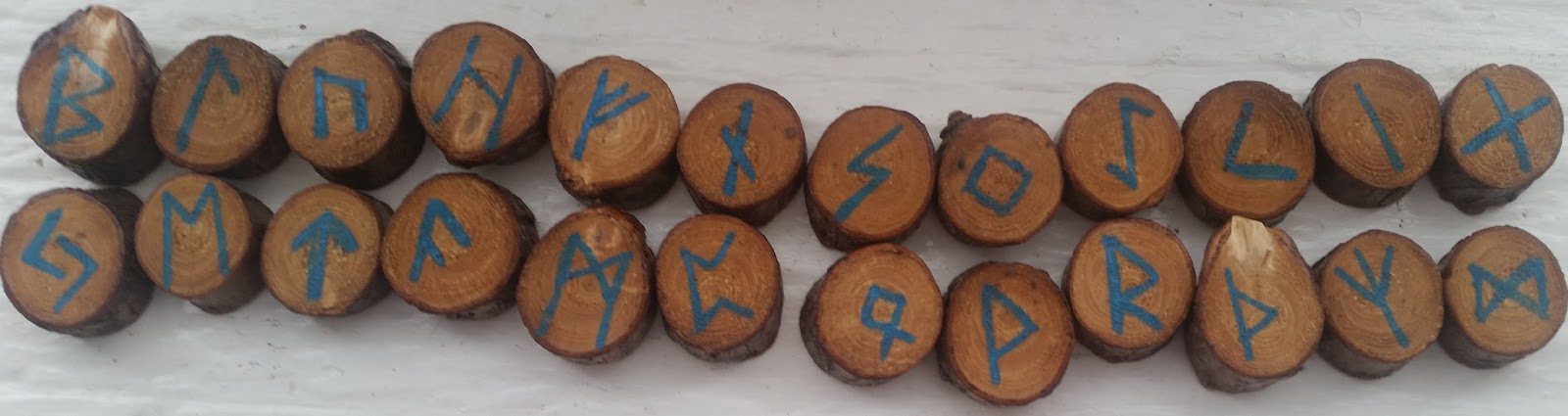
The Runes I have been using for several years were not intended to be a permanent set even though I stained them with my blood as part of the ritual.  I made them after the original staves I had been working on were ruined.  They have served me well, but I always planned to make another set and, this year, I committed to making at least three new sets of Runes.  Last week, I finished the first one.  Shells.

I have a strong connection to water and live near a lake.  Earlier this summer, I collected the shells while visiting a friend's cottage on the lake.  When I got home, I washed the shells to clean them so that I could write the Runes on them.  Though I wasn't considering this part of the ritual, I certainly felt Freyr's energy while I was doing it.

With the shells clean and dry, I painted a Rune on each one, going in order of the Elder Futhark.  I applied two coats and let them dry for several days.  I was waiting for the right moment to complete the ritual - a blessing on them.  This also got to be tricky, because I wasn't using my own blood.  When I mixed it with the paint, it changed the color.  Some say a drop of blood will suffice and that may be true, but I prefer a drop for each Rune.  Instead, I decided to take them back to the lake and rinse them in the lake water, but I had to wait for the right moment.

One morning last week, it was raining and I realized this was the moment I needed.  I put the Runes in a pouch and stopped by the lake on my way to work.  As the rain fell on that cool, misty morning, I emptied the Runes into the sand right where the water was lapping onto the shore.  It gently washed over them as I took each one separately and swirled it in the water before wrapping it into a cloth.

Although I called on Njord for a blessing, it was Freyr who presented himself more prominently.  Njord was there, but took a secondary position.  I know that neither god is associated with the Runes like Odin and Heimdall, but I requested Njord as a god with a connection to the sea.  I sometimes sense him along the shore and around marinas, so it felt right.  Still, it was Freyr who stood behind me to the left and watched as I completed my ritual.  I take his presence to mean that this was a good time, a fertile time, for me to bless the Runes and make them my own.  Even though my blood wasn't used, the water from the lake and the rain served to create that bond.

When I got home from work, I drew three Runes for myself to make them my own.  Eihwaz, Jera, and Sowilo.  These are three powerful Runes for me.  Eihwaz has become an important Rune for me when I need to be strong or calm - focused.  Jera is my guiding Rune; whenever it shows up in a draw, it is powerful.  And Sowilo is my Rune for the year, reminding me of feminine energy (to balance last year's Rune - Thurisaz).  I think this sets a good precedence for this set of Runes and the connection between them and me.


Saturday, July 22, 2017

Runes 102 - Book Reviews - Runes: Ancient Scripts

I came to the Runes through academic channels, which may be why Martin Findell's book, Runes: Ancient Scripts, caught my eye.  Though it's short, Findell provides a reasonable overview of the Runes as an alphabet, which is the primary goal of his book.

There are a number of aspects of this book that I like.  First, for those who are new to Runes, the writing isn't too dense; it does a good job of providing background on the Runes as a form of writing and communication.  And, although most of you who read my blog are engaged with Runes as an oracle, we should understand both sides of this coin.  Findell explains what Runes are in terms of a writing vehicle; he follows a chronology as the Runes changed and split from the original Futhark to the Anglo Saxon Futhorc and the Younger Futhark used in Scandinavia during the Viking Age.  I like the fact that he suggests there may have been more than a single original version of the Futhark.  There is some truth behind it if for no other reason than the existing examples of the Runic writing are scarce and there are inconsistencies in form.  It is similar to different dialects in language.

In his chapter on Rune names, Findell shows us one of the most interesting images in the entire book.  It is an 18th century copy "of an earlier late 10th-/11th-century manuscript [that] preserves the earliest [copy] of the rune-poems from which we can learn about the tradition of runes-names." The picture is from a book by George Hickes, an English Divine (church clergy) and scholar who lived from 1642-1715.  Some researchers believe that the Rune Poems were used as a way of remembering the letters of the Futharks.  I can see that given the ABC songs we are taught as children.  In modern times, we have adopted the meanings named in the poems to serve as the foundation for using Runes as an oracle.

The other insightful piece of Findell's book is his chapter on the work of Runologists.  From an academic and historical perspective, his explanation begins to lend an eye to the depth of work that has transpired to develop our understanding of runic writing and the cultures and environments in which runic inscriptions were made.  Runology, while being its own area of academic study, incorporates work in numerous disciplines - linguistics, archeology, art history, literary history, and cultural history.  I could also see anthropology and geography fitting into that mix.  Findell shares some of the challenges with interpreting inscriptions as well as the processes used to gain a full understanding of each object and not simply figuring out what is carved on it.

In his final chapter, Findell includes a nod to MR James and JRR Tolkien, but claims that there is seldom any connection between "fantasy Runes" (those developed by James and Tolkien in their books) and real Runes.  I would amend that slightly to suggest that the mistake is that some readers take James and Tolkien at face value and consider their fantasy Runes to be the real ones.  Next, he touches on the Nazi misappropriation of Runes, something that still taints the Runes and their surrounding culture.

Where I feel Findell goes astray is near the end when he seems to condemn modern uses of Runes for divination, stating that new age or pagan magic is perhaps the most prevalent present-day use of Runes.  While that remark is true, the tone of his writing changes and he seems to denounce it, stating, "Most pagan books or websites will mention the historical use of Runes as writing, but this is treated as something secondary to their symbolic and oracular function."  He further suggests that the Runes are viewed primarily as magical symbols and function as a writing vehicle "only secondarily and incidentally".  I largely disagree with this, for while Findell points out that most "pagan books and websites" present the Runes as an alphabet secondarily, that is because their primary purpose is to present them as an oracle, just as Findell presents them primarily as a written language and discusses modern uses secondarily.

I am sure there are some people who see the Runes as nothing more than a divination tool.  However, my experience has been that those who take Runes seriously and are dedicated to them as an oracle give equal credence to their history, historical culture, and role as a writing form.  This is actually why I reviewed this book; not to correct his assumptions about the Runes as an oracle, but rather to share information about the Runes as a writing vehicle, which we come to understand through the complex and multi-faceted approach that academics, like Findell, take in their work to unravel the mystery and history of the Runes and the cultural of which they were a part.